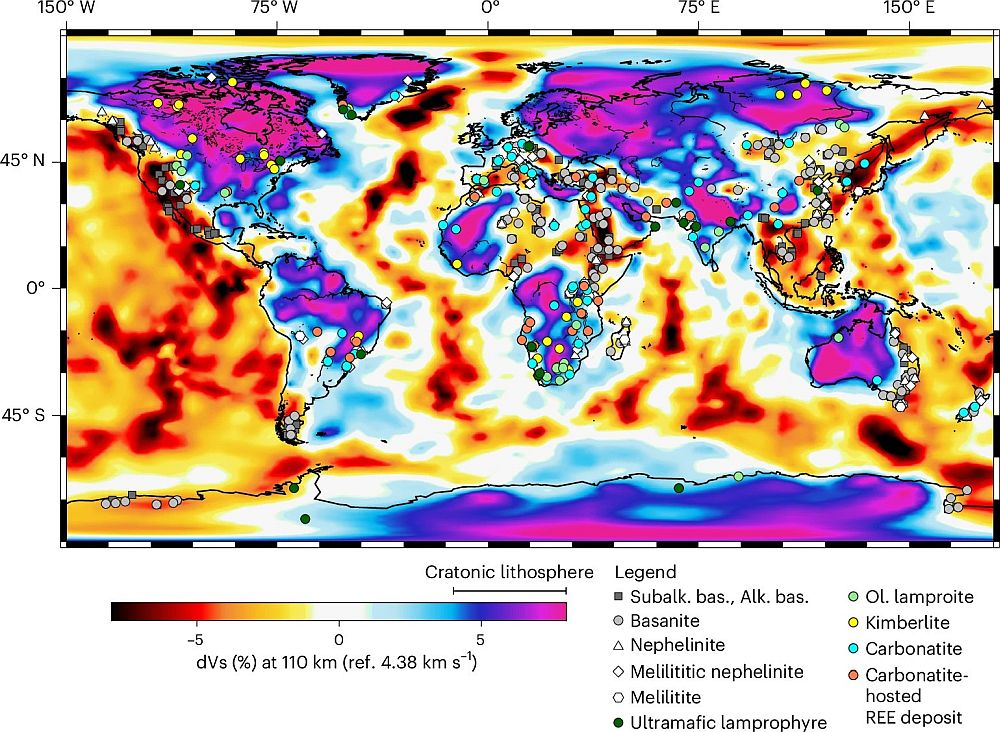
[Image above] Map showing the locations of continental intraplate CO2-rich magmas around the world, created using global shear-wave velocity anomalies data. Credit: Bowman et al., Nature Geoscience (CC BY 4.0)
While some mineral prospecting and mining booms are driven by direct financial gain—such as the use of raw gold as physical currency during the California Gold Rush—the global scramble for many other ores is driven by the development of advanced technologies that use those minerals as raw materials.
For example, during the first (~1760–1840) and second (~1870–1914) Industrial Revolutions, global demand for iron skyrocketed due to its role in both railway construction and steel production. During World War II (1939–1945) and the first half of the Cold War (1947–1970s), the need for uranium surged alongside the development of nuclear weapons.
The development of advanced electronics (1960s–1990s) followed by the push for renewable energy technologies (2000s–present) have made rare earths the “gold rush” of the 21st century. These 17 elements are relatively abundant in the Earth’s crust, but they are rarely found in concentrated, economically minable deposits.
The uneven distribution of global rare earth reserves was not a concern when these minerals were considered scientific novelties. But now that they are essential ingredients in modern critical technologies, governments around the world have made securing a steady supply of rare earths a top priority.
Finding new rare earth deposits requires prospectors to assess the regional geology and determine if it matches the environment typically expected to host rare earths. Many of these explorations focus on sites or regions already known to host other deposits, but having a stronger general understanding of what factors lead to rare earth formation might allow prospectors to conduct searches on a global scale.
In a recent open-access paper, four researchers from the University of Cambridge aimed to map the relationship between the Earth’s outermost layer, called the lithosphere, and the global distribution of carbon dioxide-rich magmas, which are important hosts of rare earth deposits.
The researchers note that previous studies have observed some relationships between lithosphere thickness and magma occurrence. However, “estimates of lithospheric thickness associated with these magma types derive from varying inversions of seismic data, thus rendering direct comparisons of lithospheric thickness among these magma types unreliable,” they write.
To enable a quantitative understanding of these relationships, the researchers assembled chemical data on 9,000 igneous rock samples from around the world and then plotted the data on a map alongside detailed information about the Earth’s interior. This approach allowed them to “show how the thickness of the lithosphere determines the generation of the full spectrum of carbonated (<5 to >25 wt.% CO2) magmas,” they write.
In general, they found that CO2-rich magmas occur along the steep edges of Earth’s thickest and oldest lithosphere. These thicker parts keep the underlying mantle rocks at high pressures and relatively cool, so only a small amount of the mantle can melt into magma. The magma then tends to get stuck at the base of the lithosphere, where it solidifies into CO2‑rich igneous rocks.
However, “it’s only when those rocks are re-melted later that the metals get a second stewing—becoming concentrated enough to form a useful ore deposit,” a university press release on the study explains.
These findings provide “predictive power for the emplacement locations of exotic CO2-rich magmas and, by inference, their associated economic deposits,” the researchers write. They now intend to extend their map to include rocks older than 200 million years old, “which host most of the economic rare earth element deposits and mines globally,” the press release explains.
The open-access paper, published in Nature Geoscience, is “The global distribution of CO2-rich magmas is determined by lithospheric thickness” (DOI: 10.1038/s41561-026-01990-7).